
Most websites don’t struggle because they lack backlinks. They struggle because they’re building the wrong ones.
I’ve reviewed backlink profiles for businesses that invested thousands of dollars into SEO, only to discover most of their links had little or no value. The reports looked impressive. Hundreds of backlinks were added every month, but rankings barely moved.
Off-page SEO is one area where poor decisions take much longer to fix than on-page issues. Once low-quality links become part of your backlink profile, cleaning them up is never as straightforward as building them. In some cases, it isn’t fully reversible. Google’s own guidance on spam updates notes that once its systems discount the effect of spammy links, any ranking benefit those links generated is gone for good, even after you remove them.
If your organic traffic has stalled or your SEO agency keeps sending monthly reports without noticeable improvements, it is worth checking whether any of these mistakes are happening behind the scenes.
1. Chasing Link Quantity Instead of Link Quality
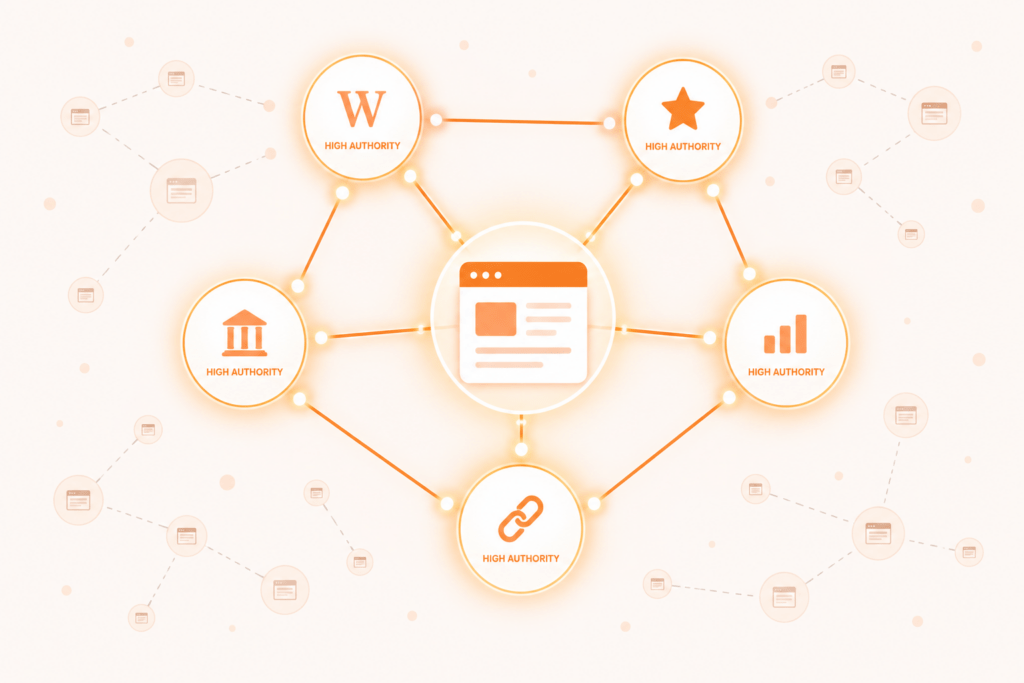
A backlink is not valuable simply because it exists. Search engines care far more about where the link comes from than how many you have.
Ten links from trusted websites in your industry will usually outperform hundreds of links from unrelated blogs or abandoned websites. This is one of the first things we walk clients through when building out a link building strategy: a smaller number of relevant, high-authority links will do more for rankings than a large batch of links from sites nobody trusts.
I still see businesses asking agencies to deliver a fixed number of backlinks every month. That often encourages volume over quality, because the agency’s incentive shifts from finding the right link to finding any link that fits the quota.
Instead, ask questions like:
- Which websites are linking to us?
- Are they relevant to our industry?
- Would we still want this link if search engines did not exist?
If the answer to the last question is no, the backlink probably isn’t worth pursuing.
2. Buying Cheap Backlinks

Buying backlinks is still one of the quickest ways to waste your SEO budget.
Many services promise hundreds of backlinks for a small fee. What they rarely mention is where those links come from.
In many cases, they come from websites built only to sell links. These sites have little authority, poor editorial standards, and no real audience. Google’s spam policies are explicit about this: any exchange of money or products for links that are meant to pass ranking value counts as a link scheme, whether the payment is disclosed or not.
Even when purchased links don’t trigger a manual penalty, they often contribute little or nothing to your rankings. If a manual action does land, Search Console’s own guidance on recovering from an unnatural links penalty requires exporting your full link list, identifying the offending links, removing or disavowing them, and then filing a reconsideration request, a process that can take weeks and still isn’t guaranteed to restore lost rankings.
If someone guarantees rankings because they can “build 500 backlinks this month,” that should raise concerns rather than excitement.
3. Building Links From Irrelevant Websites
Relevance matters just as much as authority. Imagine running a cybersecurity company and earning backlinks from gambling blogs, pet websites, or random coupon directories. Those links send mixed signals because there is no logical relationship between the websites.
A smaller website within your niche can often provide more SEO value than a large website with no topical connection to your business. [ADD HERE: a specific, real detail, a link you turned down, one that outperformed expectations, or a mismatch you caught before it went live. The UEEx case study is a good place to pull a real detail from rather than summarizing it in general terms.]
When evaluating outreach opportunities, ask one simple question: would this website naturally mention businesses like ours? If the answer is yes, it is probably worth considering.
4. Depending on Directory Submissions
Business directories still have a place in SEO. The mistake is assuming every directory deserves your listing.
Years ago, submitting websites to hundreds of directories was a common link-building tactic. Today, most of those directories receive little traffic, have weak editorial standards, and provide almost no SEO benefit. That said, a well-run directory submission service still has a place for local businesses and newer sites trying to establish a basic presence, as long as it’s targeted rather than mass-submitted.
Focus on directories that people actually use, including:
- Google Business Profile
- Industry-specific directories
- Local business associations
- Chambers of commerce
- Trusted review platforms
Quality listings help users find your business. Random directory submissions simply increase noise.
5. Ignoring Brand Mentions
Backlinks receive most of the attention, but they are only part of the picture.
Search engines are increasingly capable of understanding brands across the web, even when a mention isn’t hyperlinked. That said, it’s worth being precise about what this actually means for rankings. Google’s John Mueller has said directly that an unlinked mention is recognized as a mention but doesn’t pass PageRank or count as a link. So a mention on its own isn’t a substitute for a backlink. What it does is create an opportunity: reviews, media coverage, podcast appearances, and expert quotes all put your brand in front of an audience and an editor who has already decided you’re worth writing about. Reaching out and asking that publisher to add the link turns something with no direct ranking value into one that does.
A business that people genuinely talk about will usually have an easier time earning those links than one that only ever cold pitches unfamiliar sites. One of the easiest wins is monitoring where your brand is mentioned and reaching out to publishers who referenced your business without linking back to your website. Many are happy to add the link once you ask.
6. Using the Same Anchor Text Repeatedly
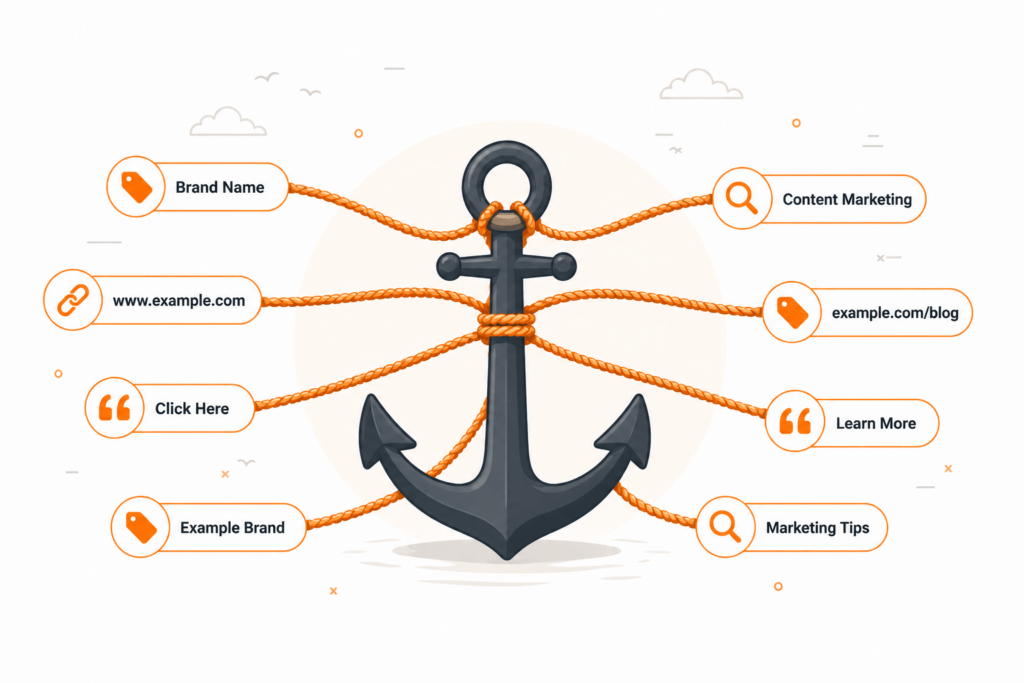
Anchor text tells search engines what a linked page is about.
The problem starts when every backlink uses the exact keyword you want to rank for. A backlink profile filled with identical anchor text looks manufactured rather than earned, and it’s one of the patterns search engines are specifically built to catch.
Natural link profiles contain a healthy mix of:
- Brand names
- Website URLs
- Generic phrases (“click here,” “this article”)
- Partial keyword variations
- Contextual anchor text that reads naturally in a sentence
If every outreach campaign targets one keyword, it is time to rethink the strategy. A simple fix is to track your anchor text distribution the same way you’d track keyword rankings, and adjust future outreach if one phrase starts dominating the profile.
7. Relying on One Link Building Method
Some businesses only publish guest posts. Others only run digital PR campaigns. Some only submit directories. No single strategy works forever, and no single strategy tends to produce the kind of steady, compounding growth that shows up in a healthy backlink profile.
Healthy backlink profiles usually grow through multiple channels, including:
- Digital PR
- Guest contributions
- Resource page outreach
- Linkable assets and original research
- Industry partnerships
- Podcasts and expert roundups
This is one reason our case studies for clients like Solevant and UPay lean on a mix of content updates, targeted outreach, and linkable resources rather than one repeated tactic. Solevant picked up dozens of referring domains organically once the content itself gave other sites a reason to link, not because of a single outreach push. The more naturally your links are earned across different channels, the stronger your backlink profile becomes over time.
8. Never Auditing Your Backlink Profile
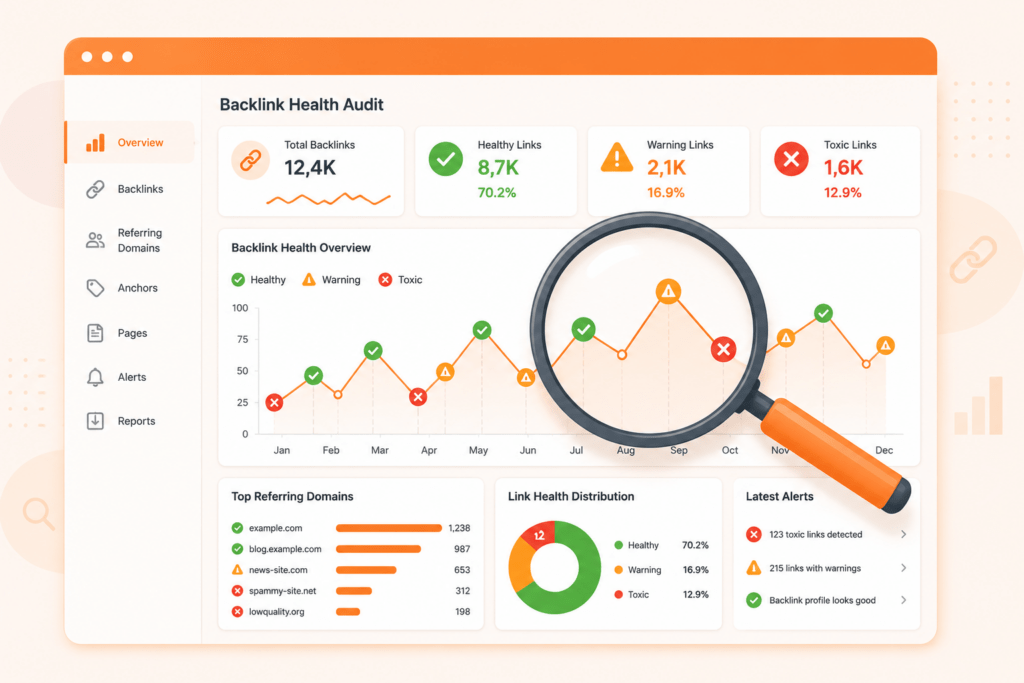
You cannot improve what you never review. Websites lose backlinks every month. New backlinks appear without your knowledge. Occasionally, low-quality websites begin linking to your content without being asked.
Without regular backlink audits, you miss opportunities to recover valuable links while allowing poor-quality links to accumulate. You also won’t catch a problem early enough to fix it before it turns into a full manual action, which is a far more painful and time-consuming process to reverse.
At minimum, review your backlink profile every few months. You don’t need an expensive enterprise suite to do this. Free and open-source options like the ones we cover in our roundup of marketing tools worth knowing can track new referring domains, flag anchor text patterns, and monitor overall link growth without adding another line item to your budget.
Look for:
- Lost high-authority links
- Toxic or spammy domains
- Anchor text distribution
- Link growth trends
- New referring domains
This gives you a clearer picture of whether your off-page SEO efforts are moving in the right direction.
9. Treating Off-Page SEO as Link Building Only
This is probably the biggest misconception I see.
Off-page SEO extends beyond backlinks. Every positive signal your business earns across the web contributes to your authority, and a lot of that signal has nothing to do with a hyperlink.
That includes:
- Industry recognition
- Customer reviews
- Digital PR coverage
- Community engagement
- Social visibility
- Podcast interviews
- Expert contributions
- Branded search volume
Strong brands naturally attract links because people already know and trust them. This is part of why our SEO content creation work always starts with the content and the brand story first. The backlinks tend to follow once there’s something worth linking to.
If your entire strategy revolves around getting another backlink, you are missing opportunities that often have a greater long-term impact.
What This Means For Your Strategy
There is no shortage of link-building tactics online. The challenge is knowing which ones still deserve your time.
Off-page SEO works best when every backlink has a clear reason to exist. It should come from relevant websites, support your brand, and provide value beyond search engine rankings.
If you find yourself reporting backlink numbers instead of business results, pause and review the strategy.
A smaller number of relevant, trustworthy links will almost always outperform hundreds of links built simply to hit a monthly target. If you’re not sure where your current backlink profile stands, Contentika offers a free website audit as a starting point before committing to a longer engagement.
Frequently Asked Questions
Is buying backlinks ever worth the risk?
Rarely. Even when a purchased link doesn’t trigger a manual penalty, it tends to carry little ranking value because it wasn’t placed for editorial reasons. Google’s spam policies treat any paid link meant to pass ranking credit as a link scheme, and recovering from a manual action once one lands is slow and not guaranteed to restore what you lost.
How many backlinks does a website actually need?
There’s no fixed number. Ten links from relevant, trusted sites in your industry will typically outperform hundreds of links from unrelated or low-authority sites. Chasing a monthly quota usually pushes an agency toward volume instead of relevance.
Do unlinked brand mentions help SEO?
Not directly. Google has said an unlinked mention is recognized as a mention but doesn’t pass PageRank the way a link does. What it does is signal that a publisher already trusts your brand, which makes it easier to ask them to add the link.
How often should I audit my backlink profile?
At minimum every few months. Links get lost, new ones appear without your involvement, and low-quality sites sometimes link to you unprompted. A regular audit catches problems early, before they turn into a manual action that takes far longer to fix.
Is off-page SEO the same thing as link building?
No. Link building is one part of it. Reviews, digital PR, podcast mentions, community engagement, and branded search all contribute to off-page authority, and a business people already talk about tends to earn links more easily than one relying on outreach alone.