
A content repurposing strategy is the process of taking one piece of pillar content (a blog, video, or podcast) and systematically breaking it into multiple smaller assets, like carousels, reels, threads, and quote graphics, distributed across platforms over weeks instead of once. Done right, it can multiply the reach of a single piece of content 5 to 10 times without creating anything new from scratch.
Post once. Reuse it 10+ times. Reach more people with less effort. Nature has been doing this with water for millions of years: evaporation, condensation, precipitation, collection, repeat. Most brands treat content like single-use plastic. This guide shows you how to treat it like water instead.
Why Most Content “Evaporates” and Disappears

If you’ve ever spent four hours writing a blog, posted it once on LinkedIn, and never looked at it again, you’re not alone. That’s the trap most founders and marketers fall into: Create, post once, panic, and create something new.
It feels productive. It isn’t. Here’s what that cycle actually costs you:
- Burnout. You’re on a content treadmill: new idea, new graphic, new video, every single day. Most teams run out of steam by week three.
- Low ROI. You invest hours into one pillar piece, and the majority of your audience never sees it, or sees it only once, because it was never redistributed.
- Inconsistent growth. Platforms reward consistency and momentum. Posting once and disappearing makes a brand forgettable. No compounding, no repeat traffic.
The problem isn’t that the content is bad. The problem is that it’s treated as a pipeline instead of a cycle. A pipeline is linear: make it, ship it, done. A cycle is circular: make it, break it down, reshape it, redistribute it, and bring people back to the source. That’s the Content Water Cycle.
How to Choose What’s Worth Repurposing
Not every piece of content deserves the full cycle. Before you evaporate anything, audit what you already have and look for one of three signals:
- Steady organic traffic. A blog post or page that keeps pulling in search visits months after publishing already has proven demand behind it.
- Strong engagement. A LinkedIn post, video, or newsletter that got unusually high comments, shares, or saves is telling you the idea resonated, and resonance travels well across formats.
- Strategic relevance that hasn’t been fully explored. Sometimes a piece covered an important topic but only scratched the surface. That gap is an opening, not a dead end.
If a piece of content has none of these signals, it’s usually better to improve or retire it than to spend a repurposing cycle on it. Repurposing works because it takes something that’s already validated and gives it more surface area, not because it can rescue weak content.
The 4 Stages of the Content Water Cycle
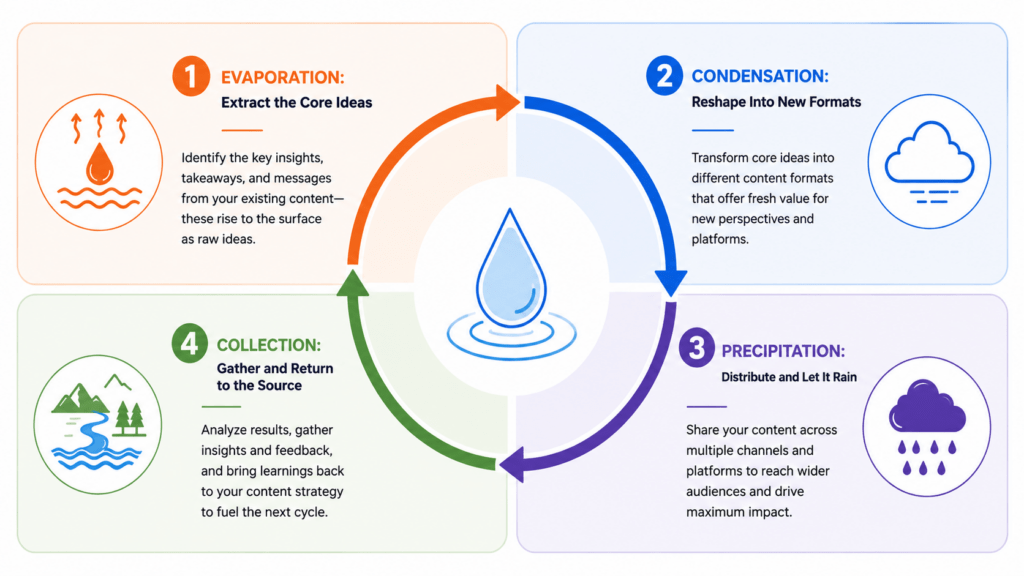
Think of your best blog, video, or webinar as the “ocean,” big, full of value, but nobody drinks straight from the ocean. To become usable and far-reaching, it has to move through four stages.
1. Evaporation: Extract the Core Ideas
Water turns to vapor; long-form content turns to standalone snippets. This is where you go back into your pillar piece and deliberately pull the value out of it.
How to do it:
- Start with one strong pillar: a 10-minute YouTube video, a 1,500+ word blog, a podcast episode, or a webinar.
- Mine it for 5 to 10 standalone insights: stats, frameworks, stories, quotes, mistakes, wins.
- Ask of each one: “Could this single point stand alone as its own post?”
Example: A pillar blog titled “How to Bake the Perfect Loaf of Bread at Home” evaporates into:
- Tip: “Why your dough isn’t rising (and how to fix it)”
- Tip: “The one ingredient most beginners skip”
- Insight: “The single change that made the biggest difference in my bread”
Key rule: If you can’t pull at least five strong standalone ideas from a piece, the pillar isn’t substantial enough yet. Go back and build it out further before repurposing.
2. Condensation: Reshape Into New Formats
Vapor becomes clouds; ideas become new content types. Same message, new container, built for how each platform’s audience actually consumes content.
| From Your Pillar | Condense Into |
|---|---|
| Blog section | LinkedIn carousel, X/Twitter thread, IG slides |
| YouTube video | 30-second Reels, TikToks, Shorts, soundbites |
| Podcast | Quote graphics, key takeaway posts |
| Data or stats | “Growth by numbers” charts, infographics |
| Framework | Checklist PDF, one-page template |

Example: The bread-baking tip becomes a 7-slide LinkedIn carousel (“5 Mistakes Killing Your Homemade Bread”), a short Instagram Reel of the dough-rising technique, an 8-step X thread, and an email subject line built around the secret ingredient. One idea, four-plus clouds, ready to rain.
Tools that help: you don’t need a full production team to condense at scale. Tools like Canva or Adobe Express speed up carousel and quote-graphic design, CapCut or Descript can turn a long video or podcast into short clips with captions already burned in, and a general repurposing tool can take a full article and suggest an outline for a thread or carousel that you then tighten and fact-check by hand. None of these replace judgment. They just remove the blank-page problem so you can spend your time on the parts that actually need a person: the angle, the hook, and whether the reshaped piece still says something true.
3. Precipitation: Distribute and Let It Rain
Clouds release rain; reshaped content reaches new audiences. This is the distribution stage, where the value actually lands.
How to do it:
- Schedule strategically; don’t release everything on the same day.
- Use platform-native best practices for hooks, visuals, and calls to action.
- Always include a path back to the original pillar (“Full recipe in the blog, link in bio”).
- Track timing and format performance, then double down on what works.
Example: Over one week, three short Reels go out on Instagram and TikTok, a LinkedIn carousel posts midweek, an X thread invites reader questions, and a newsletter snippet lands with one key tip. The original blog gets a fresh wave of traffic days or weeks after publishing, not just on day one.
Pro tip: Precipitation isn’t one and done. Repost top performers every 30 to 60 days with slight variations in hook or format.
4. Collection: Gather and Return to the Source
Rain feeds rivers, and rivers return to the ocean. This final stage closes the loop: the distributed content drives the audience back to the core asset, where the deeper value lives.
How to do it:
- Use strong calls to action: “Read the full guide,” “Download the checklist,” “Watch the full video.”
- Capture emails or community sign-ups at the point of return.
- Analyze what performed best and feed that insight into the next pillar piece.
- Nurture the audience that arrives through newsletters, retargeting, and community touchpoints.
Example: The repurposed bread content drives readers back to the full blog post and a free “Beginner Bread Checklist” download. Viewers of the short-form videos subscribe to the newsletter for more recipes. One pillar piece ends up supporting weeks of activity instead of a single day.
Common Mistakes That Undo a Repurposing Strategy
Even with the four stages in place, a few habits quietly break the cycle before it compounds.
- Cross-posting instead of reshaping. Pasting the same paragraph on every platform isn’t repurposing, it’s just distribution, and audiences notice when a post clearly wasn’t built for where they’re seeing it. Each format needs its own edit, even if the underlying idea stays the same.
- Diluting the core message. Chasing more assets by stretching thin ideas across too many formats leaves every piece feeling shallow. Five strong ideas beaten out of one pillar work better than fifteen ideas that state the same shallow point over and over.
- Skipping the return path. If every repurposed post is a standalone piece of value with no CTA or link back to the source, you’re giving away the value without ever collecting the audience. Collection isn’t optional, it’s the stage that turns reach into an actual list or following.
- Treating repurposing as a rescue plan. Weak or outdated content doesn’t get better by being cut into ten pieces. If the pillar itself is thin, fix or replace it before running it through the cycle.
- No system for tracking what worked. Without checking which reshaped format actually drove traffic or engagement, there’s no way to know what to repeat. Even a simple spreadsheet noting which posts performed best per platform makes the next cycle sharper than the last.
Ready to Build Your Own Content Water Cycle?
Start simple: pick one existing pillar piece this week, run it through Evaporation and Condensation, then distribute and watch it rain. Your content deserves to live longer than one post. Turn it into a cycle and let it compound.
FAQ
What is a content repurposing strategy? It’s a system for turning one piece of pillar content into multiple smaller, platform-specific assets, like carousels, reels, threads, and graphics, distributed over time instead of publishing something once and moving on.
How many times can I repurpose one piece of content? There’s no hard cap. A single strong pillar piece can realistically support 10 to 15 repurposed assets across formats, and top performers can be reposted again every 30 to 60 days with a fresh hook or angle.
What’s the best repurposing cycle for LinkedIn vs. TikTok? LinkedIn audiences respond well to carousels and text-based breakdowns of frameworks or data. TikTok and Instagram Reels favor short, single-idea video clips under 30 seconds. The same underlying insight can feed both; the format is what changes.
Do I need a large pillar piece to start repurposing? Yes, ideally. If you can’t extract at least five standalone ideas from it, the source content likely isn’t deep enough yet to sustain a full repurposing cycle.
How is this different from just cross-posting the same content everywhere? Cross-posting reuses the same format across platforms. Repurposing reshapes the underlying idea into the format each platform’s audience actually prefers. A stat becomes an infographic, a story becomes a carousel, a framework becomes a checklist.
How do I know which content is worth repurposing? Look for pieces with steady organic traffic, unusually strong engagement, or a strategically important topic that wasn’t fully explored the first time. Content without any of those signals is usually better off improved or retired than repurposed.
What’s the biggest mistake people make when repurposing content? Cross-posting the exact same text everywhere without reshaping it for the platform. It reads as lazy, underperforms, and skips the actual work that makes repurposing effective in the first place.